Cassettes Section: Page 20-B

Click on an underlined item or scroll down this page to view everything.

- Torque Wrench Use -

- What does a Torque Wrench measure? -

- Suggested Torque Settings for Bike Components -

- Newton/Meters and Foot/Pounds Conversion Chart -

All information is courtesy of Park Tool


Torque Wrench Use
 
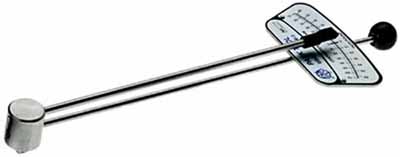
Park TW - 1 Torque Wrench
Park Torque Wrench


Use of Beam Torque Wrenches, Park TW-1 and TW-2

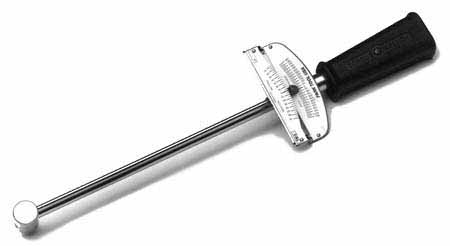
The Park TW-1 and TW-2 are simple in their operation. Both tools are accurate and durable. The TW-1 is a 1/4 inch drive, and the TW-2 accepts 3/8 inch drive sockets.

On either tool, the larger steel beam or rod flexes as you tighten any bolt. The more force you apply to tighten your bolt, the greater the steel beam will deflect. The smaller beam with a pointed end does not deflect. It is a reference for the larger beam.

To check tool calibration look at the pointed indicator when you are not tightening a bolt. If it is pointing at 0, it is accurate. If it is off, bend the indicator unit until it points at 0. Park wrenches are accurate both for both left and right hand torque. The beam will never fatigue and lead to inaccurate readings. For greatest accuracy, use a thread preparation, either grease, lube, or an appropriate grade of Loctite, on the threads of the bolts you wish to tighten.

See Recommended Torque for more information regarding torque settings for various bicycle components.

Park TW - 2 Torque Wrench
Park TW-2
 
 
What does a Torque Wrench measure?


TORQUE and TORQUE WRENCHES

Nuts and bolts are held together by tension or elasticity. Threads provide a continuously inclined plane, which creates a wedge for the bolt when you tighten the nut. Like a rubber band, metal is elastic, and will stretch a little as you tighten a nut. If you overtighten a nut you will go past the limits of the metal's elastiticity and strip the threads. If you under tighten, the bolt will not stretch and thus will loosen more easily through normal use. A torque wrench allows you to tighten the bolt and nut to the correct tension, so it will stay in place without loosening.

Torque is simply a twisting or turning motion around the axis of the nut or bolt. Torque wrenches measure resistance to rotation. This resistance can be correlated to, but is not a direct measurement of, fastener tension. Generally, the higher the resistance to rotation, the greater the tension on the threaded fastener.

Typically, lubrication is desired in the thread and at the bolt head. Without lubrication, a higher twisting resistance is felt by the torque wrench. The torque wrench reads only this resistance to rotation, it does not directly read the tension in the bolt. Consult the component/bicycle manufacturer for proper thread preparation if in doubt.

Another option for thread preparation is a thread locking compound, such as from Loctite®, Wurth®, and Devcon®. This is a fluid that is applied to clean threads. The fluid provides some lubrication during torque. When sealed from air, the fluid hardens and expands as it cures. This provides resistance to loosening and also forms a seal to water and corrosion. Thread locking compounds can be useful when parts cannot be fully torqued. For example, older aluminum chainring bolts should use a thread locker as they cannot be tightened as much as steel chainring bolts. Newer alloy chainring bolts are cut from 7000 series aluminum and are almost as strong as steel ones. Thread lockers should not be used to replace proper torque and thread pre-load when clamping load is important. Generally, the service removable grades are used, such as Loctite® #222 or #242.

Cross threaded parts will cause more resistance than correctly aligned threads. A torque wrench is unable to distinguish this problem. It is the responsibility of the mechanic to check thread alignment.

It is important to understand torque unit specifications. For example, securing crank arms to 25 inch pounds is not the same as securing it to 25 foot pounds.

The most common reason for threaded fasteners loosening is simply that they were inadequately secured during initial assembly. Vibration, stress, or use/abuse usually will not cause a properly sized and secured threaded fastener to loosen.

Below is list of available bicycle specific torque specifications. Some manufacturers do not specify torque for their product.

In the USA, the common unit used to measure torque is the inch-pound. This is a force of one pound acting at the end of a lever (wrench) only one inch long. Another unit is the foot-pound, which is the force in pounds along a one foot long lever. It is possible to convert between the two units by multiplying or dividing by twelve. 12 inch pounds equals 1 foot pound. Because it can become confusing, it is best to stick to one designation. Park Tool torque wrenches are calibrated in inch-pounds.

 
Suggested Torque Settings
 

All figures are inch-pound. Some companies do not specify torque for certain components or parts.

Component Shimano
in-lb.
Barnett’s Manual Recommendation Other-
in-lb.
Wheel, hub, rear cog area . . . .
Spoke tension n/a n/a Spokes are measured with tension, not torque at nipple. Contact rim manufacturer for specific tension recommendations
Quick release-closed cam type n/a n/a Measured torque not typically used. Common industry practice: Resistance half way through swing
Axle nuts to frame
(non-quick release type wheels)
260-390 Front 180-240 Rear 240-300 Sachs 312
Control Tech 65 (steel)
Control Tech 85 (titanium)
Cassette sprocket lockring 260-434 265 Sachs 354
Campagnolo 442
Hub cone locking nut 87-217 120-180  
Freehub body 305-434 310  
Headset, handlebar, seat and seat post area. .. .
Headset locknut-threaded   300 Tange-Seiki 217
Chris King Gripnut type 130-150
Stem binder bolt- quill type 174-260 145-180 Control tech 144-168
MTB handle bar end extensions   120-145 Control Tech 144
Stem binder- threadless type   85-double bolt
100- single bolt
Control tech 120-144
Syncros cotter bolt type 90
"Grip Shift" mounting screw   20 Sachs 13-22
Handlebar binder 174-260 120-145 if 6mm thread
205-240 if greater than 6mm thread
Control Tech 120-144
Seat rail binder 174-347 120-145 single bolt
85-95 double bolt
Control Tech, 2 bolt type 144
Control Tech, single bolt 300
Syncros each 45
Seat post binder     Campagnolo 36-60
Crankset and pedal area . .. .
Pedal into crank 307 minimum 300-360 Ritchey 307
Campagnolo 354
XTR crankarm bolts 357-435    
Crankarm bolt (including spline-type cranks and square-spindle cranks) 305-391 390 max. Sachs-336 max.
White Ind.- 240-300
Syncros-240
Campagnolo-312-324
Chainring cassette to crankarm (lockring) 443-620    
Chainring bolt- steel 70-95 50 Sachs 53
Campagnolo 84-120
Chainring bolt aluminum 44-88    
Bottom bracket
adjustable type
609-695 300- left lockring
360 fixed cup
(using Loctite #242 on fixed cup)
 
Bottom bracket cartridge type 435-608 260-350 White Ind. 240
Real 432-612
Campagnolo 612
Derailleur and shift lever area . .. .
STI type shift lever binder 53-69 50  
Shift lever- MTB "thumb type" 22-26 20-25  
Front Derailleur clamp mount 44-60 40 Sachs 26-36
Campagnolo 61
Front derailleur cable pinch 44-60 35 Sachs 44-50
Campagnolo 44
Rear derailleur mounting bolt 70-86 70 Sachs 54-72

Campagnolo 133

Rear derailleur cable pinch bolt 35-52 35 Sachs 44-53
Campagnolo 53
Rear derailleur pulley wheel bolt 27-34 20- alloy Sachs 44-53
Brake caliper and lever area . .. .
Brake caliper mount to frame, side/dual/center pull 70-86 70-85 Cane Creek 72-84
Brake caliper mount to braze-on 44-60 25 with mild thread locker Control Tech 100-120
Brake pad- threaded stud, cantilever or sidepull 53-69 50-60  
Brake pad- smooth stud, cantilever 70-78 70-80  
Brake cable pinch bolt- cantilever 53-69 50-70 Control Tech 40-60
Brake cable pinch bolt- sidepull/dualpull/centerpull 53-69 50-70 Cane Creek 68-72
Brake caliper arm pivot- dual pivot 70-86 50-70 Cane Creek 72-84
Sidepull/dual pivot brake pad bolt 44-60 50-70 Cane Creek 56-60
Cantilever straddle wire pinch 5x 0.8 thread 35-43 50-70 Control Tech 40-60
Brake caliper straddle wire pinch 6 x 1 thread 50-75 50-70  
Brake lever-MTB type 53-69 35-60  
Brake lever-drop bar type 53-69 70-85 Sachs 88
Campagnolo 88

 
Conversion Chart
 

TORQUE EQUIVALENCIES

Inch pound
in-lb.

Approximate
Foot pound
ft-lbs

Approximate Newton Meter Nm

10

0.8

1.1

12

1.0

1.4

20

1.7

2.3

30

2.5

3.4

40

3.3

4.5

50

4.2

5.6

60

5.0

6.8

70

5.8

7.9

80

6.7

9.0

90

7.5

10.2

100

8.3

11.3

110

9.2

12.4

120

10.0

13.6

130

10.8

14.7

140

11.7

15.8

150

12.5

16.9

160

13.3

18.1

170

14.2

19.2

180

15.0

20.3

190

15.8

21.5

200

16.7

22.6

210

17.5

23.7

220

18.3

24.9

230

19.2

26.0

240

20.0

27.1

250

20.8

28.2

260

21.7

29.4

270

22.5

30.5

280

23.3

31.6

290

24.2

32.8

300

25.0

33.9

310

25.8

35.0

320

26.7

36.2

330

27.5

37.3

340

28.3

38.4

350

29.2

39.5

360

30.0

40.7

370

30.8

41.8

380

31.7

42.9

390

32.5

44.1

400

33.3

45.2

410

34.2

46.3

420

35.0

47.5

430

35.8

48.6

440

36.7

49.7

450

37.5

50.8

Formulas for converting other torque designations into inch pounds (in-lb.).

in-lb. = ft-lb. × 12
in-lb. = Nm × 8.851
in-lb. = kgf-cm / 1.15


Click below to go back to the Cassette Tools page...